Fit Out: Missions and Evangelism as Tools for Authentic Faith - Settles Lecture 4.3.25
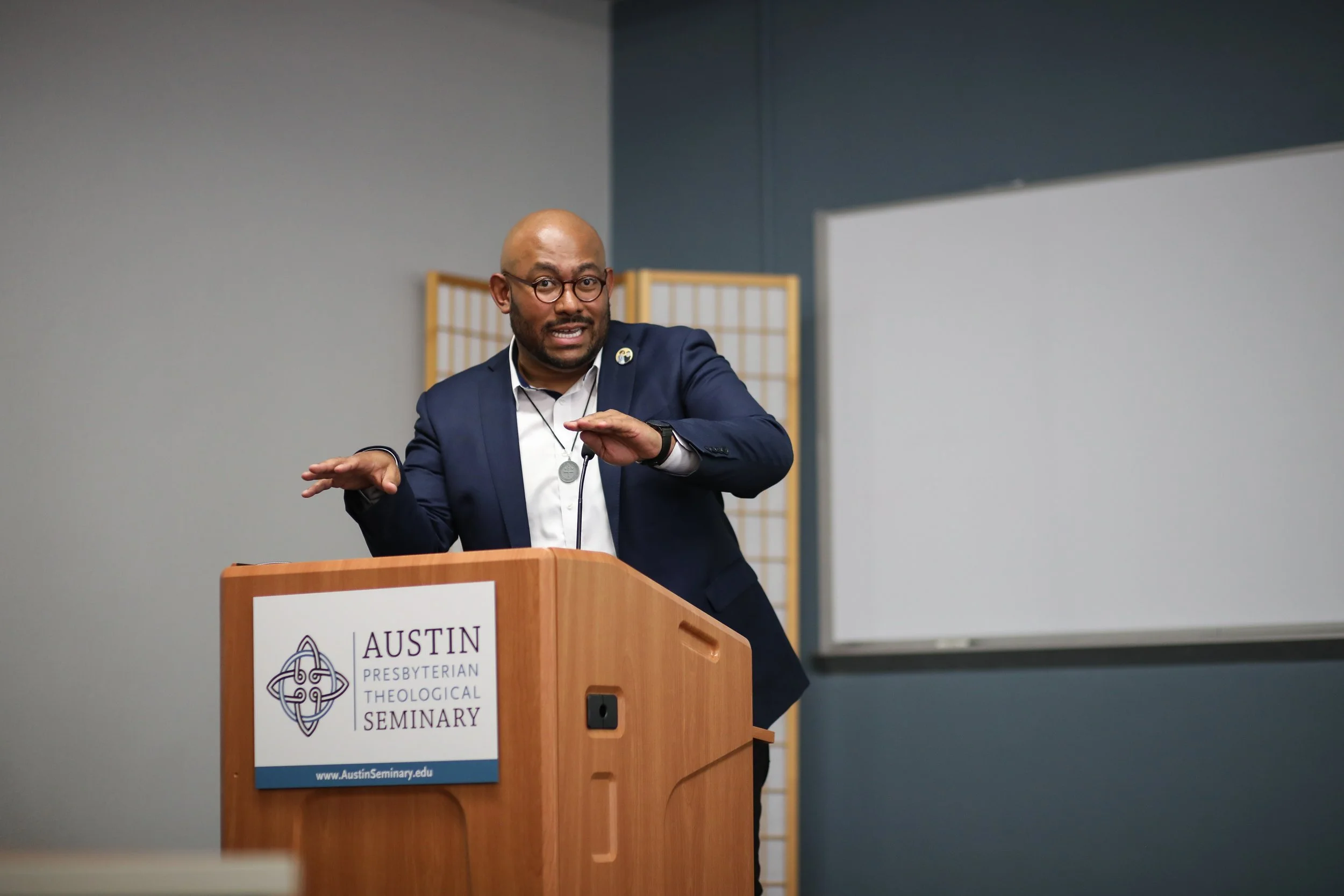
Good afternoon everyone,
Thank you so much for the invitation to speak at this year's Settles Lecture. I'm truly humbled by the opportunity to share my thoughts on this stage, a stage graced by such esteemed ancestors and elders such as James Cone, Justo Gonzalez, Gustavo Gutierrez, Anthea Butler, and Arun Jones. I am grateful to Dean Margaret Aymer, Alison Riemersma, and Crystal Sylva-McCormick for this invitation and for the work that they do, and thank you all for being here today.
And as we thank our ancestors, I'd like to bring up the names of some of my own, my father Floresmiro Perea and mentors Miriam Jimenez Román and Juan Flores. These ancestors and countless others have paved the way for us to be where we are today. Even Jesus, at the moment of his transfiguration, had ancestors appear by his side to confirm his time and it is always important for us to know just how much our ancestors are part of our lived experience.
We've gathered today to discuss missions and evangelism, two topics that hold a complex and, frankly, sometimes troubled place in the church's history. While I don't claim to be a professional church historian – though I've certainly spent my share of time exploring the subject – it's undeniable that the origins of modern missions and evangelism were rooted in a desire to fulfill the Great Commission: to go forth, make disciples, and reach the furthest corners of the earth. However, this noble ambition has, at times, been overshadowed by practices that strayed from its intended spirit, leading to a mixed legacy we must acknowledge.
However, a critical shift occurred as Christianity became Colonized by the Romans and entangled with the forces of empire. The very nature of proselytizing underwent a disturbing transformation. Instead of missions and evangelism serving as instruments for the organic growth of faith, they were tragically repurposed as tools of oppression and persecution, as tools of empire. Forced conversions became a strategic weapon in the imperial arsenal. While it's crucial to acknowledge that not all missionaries participated in these atrocities, the ministries of evangelism and missions became inextricably linked to the imperial enterprise, fundamentally altering the very essence of Christianity. This historical reality demands our honest reflection and a commitment to understanding the complex legacy we inherit.
Adding to this deeply problematic history is the Doctrine of Discovery. This concept, rooted within the Catholic Church, went far beyond simply justifying forced conversions and the persecution of other faiths. It laid the groundwork for a far more insidious framework: the systematic theft of land and the entrenchment of racial hierarchies. This toxic combination of religious justification and imperial ambition produced the deeply incompatible and damaging messages that have plagued our history. It created a system where the very presence of indigenous people and their cultures was seen as an impediment to the expansion of 'civilization', a tragic legacy we continue to grapple with today.
We cannot shy away from the uncomfortable truths of our past. Even figures like Bartolomé de las Casas, sometimes lauded as saints, were deeply flawed. His history as a slaveholder and his racist ideologies demand that we critically examine the narratives we've been told and resist simplistic and supremacist portrayals of history.
The sheer absurdity of our history is staggering. We, the church, carried enslaved people on vessels named for the Trinity, the Holy Spirit, to cities named for the Savior. It's a twisted, almost unbelievable contradiction that screams for an answer. We must ask ourselves, with unblinking honesty, 'What were we doing?' And I hold onto the faintest hope that we will finally find the courage to confront this hypocrisy.
The imperial project drastically distorted the core purpose of missions and evangelism. We witnessed a hijacking of the faith, a co-opting that tethered Christianity to capitalism, militarism, and ideologies fundamentally opposed to its original, uncolonized essence. This betrayal demands that we grapple with the profound damage inflicted and seek a path toward restoration
And so, here we stand in 2025 and the search for authentic missions and evangelism is more vital than ever. What does it genuinely mean to answer that call? How do we reconcile the profound discrepancies between the original intent and the historical reality we inherit? How do we find a path forward that honors both truth and transformation? The great prophet from Compton Kendrick Lamar, in a recent song 'Reincarnated,' speaks of rewriting the devil's story to reclaim power. How can we, too, exercise that agency, transforming the narratives of missions and evangelism that have shaped its expression, and taking back what was lost?
A little over a month ago, I embarked on a pilgrimage to the Abbey of Keur Moussa in Senegal. The image you see before you is from their altar, and it captures something of the spirit of that place. This monastery is famous for its powerful visual art – the wall and frescoes – and for its choral traditions, which are unlike anything I've ever experienced.
As I sought to explore the connections between Blackness and contemplation, I was drawn to Africa, the birthplace of monasticism, where I felt I would find deeper understanding about some aspects about Christianity.
Christianity, though woven into the fabric of Africa, has a shorter, more complicated history in Senegal. Some French monks arrived with the tide of colonization, a period marked by profound exploitation. I asked the monks, with genuine curiosity, how they navigate their relationship with a predominantly Muslim society and how they reconcile their order's arrival with the colonial era.
The monk I spoke with the most while I was there, Brother Thomas, told me a revealing story that answered some of my questions. In the monastery's early days, the French monks wanted to bring a French organ and create images of Jesus based on their own cultural context—a white, French man. However, they soon understood that they were unintentionally attempting to make the Senegalese people fit into their way of understanding faith and seeing the divine, rather than allowing a truly indigenous expression to emerge.
However, one of the brothers offered a transformative suggestion: if the monastery was to truly resonate with the Senegalese people, it needed to reflect their culture. This led to a complete shift, beginning with the images. They understood that if people couldn't see the Divine reflected in their own likeness, how could they possibly forge a genuine connection?
So they transformed the images within the monastery and commissioned one of their brothers to create these beautiful frescoes. The frescoes, strategically positioned on the church's main wall, serve as a way to allow people to embrace the divine. When I had a chance to chat with Brother Thomas and asked him about the frescoes, he explained that “To fully embrace faith, especially Christian faith, we require visual access, and Christian art provides that. These frescoes, rendered in flat, expressive tones of black, red, yellow, and white, while maybe not very elaborate, are expressive. They mean something.”
And the transformation extended to the music. Instead of relying on traditional Gregorian chants and European instruments, the monastery actively collaborated with local leaders. They embraced the Kora, the djembe, the sabar, and the balafon, ensuring that the music resonated with the community, rather than forcing the community to adapt to foreign sounds.
I discovered a similar story from the Congo, a nation with a deeply painful colonial past that resonates to its present. Christianity there, too, arrived with empire, often used as a tool of oppression, forced upon the people and the land. But amidst this darkness, one priest offered a different path. Father Guido Haazen, a white Belgian, arrived in the early 1950s, not to impose, but to learn. Unlike most Belgian missionaries around that time, he respected the ancestral traditions of the Congolese people. By gathering fifteen young boys and forming Les Troubadours du Roi Baudouin, he taught Christianity with the heart of a servant, loving his young Black neighbors as himself. He communicated, through his actions, a powerful message: 'I honor your ways, and those of your ancestors.’
Another powerful example comes from the Māori influence on the New Zealand Book of Common Prayer. By incorporating Māori-inspired prayers and language, the church created a space where the Māori people could authentically embrace the gospel. This approach moved away from imposing an alien faith, and instead, empowered them to experience Christianity within their own cultural context.
I'm not sure how many basketball enthusiasts we have in the room, but a recent, high-profile trade that affected the state of Texas involved a superstar joining a new team. Usually the question is always asked, how can a player fit-in to the team, how can it work for him to change his game? But this time LeBron James gave Luka Dončić a powerful piece of advice: 'Don't fit in, fit out.
'Fit out.' I believe that encapsulates the essence of how we must approach missions and evangelism today. We need to cultivate a posture of humble mission and evangelism, one that prioritizes creating pathways for people to shape our practices, ensuring they resonate with their lived experiences, rather than forcing them into our pre-conceived molds.
A church that encourages people to 'fit out' is a church that embraces its God-given diversity. It strives to live out Jesus' example of seeking, not being sought. It's a community that values individual contributions, allowing them to shape its identity. This is a church that understands and reclaims missions and evangelism as pathways to authentic faith expression, not as extensions of imperial power.
And this principle of 'fitting out' isn't limited to our approach to missions; it must permeate every facet of our faith. We need to reimagine how we engage with scripture, creating spaces where individuals can truly be themselves in worship, in the everyday rhythms of Christian life, in every aspect of our spiritual journey.
Maybe, our task is equally about adding new ideas and more about critically examining and discarding the old. What if we begin by rejecting the problematic constructs of missions and evangelism that have been internalized? It is through this process of deconstruction and reconstruction, by embracing liberative concepts, that we can truly be missional in our work.
And this work is urgent. As De La Soul, those prophets from Long Island, warned in 'Stakes Is High,' 'Neighborhoods are now hoods 'cause nobody's neighbors.' The stakes are indeed high. The world demands a broader, more inclusive expression of love. We can no longer afford to ignore the truth. We must transform our approach to teaching Christianity, our understanding of missions and evangelism, into something that leads us to a fuller, more authentic embodiment of the way of Jesus.